🔥 “Taiwan’s Industrial AI Deployment Trends × IMV Technology Innovation Awards × Top 100 Enterprise AI Applications” — How Does PSF Read This Signal?
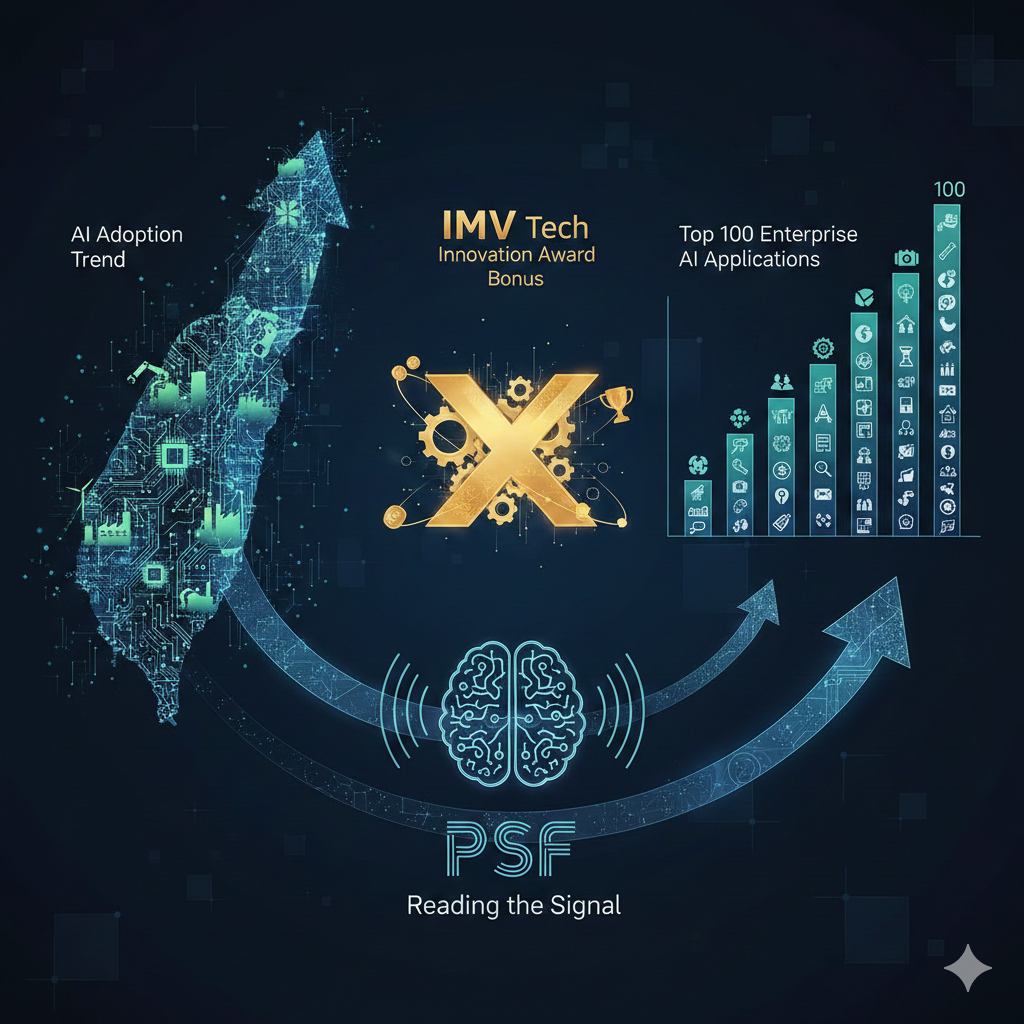
Taiwan’s AI Has Officially Entered the “Deployment Wave”
And PSF Has Chosen to Stand in the Hardest and Most Critical Position
I have always believed that
what truly changes an industry is never the technology itself
but “who is willing to take it all the way through the last mile.”
Over the past two years, Taiwan has talked a lot about AI.
Models, generative AI, Agents, RAG, compute, GPUs —
every term is advanced and every one is buzzing.
But the real questions are actually simple:
Has AI really entered the process?
Has it really brought costs down?
Has it really made people stronger rather than more tired?
I recently went through several sets of material —
including industrial AI deployment trends, the IMV Technology Innovation Awards and Business Weekly’s “Top 100 AI Innovations.”
The conclusion is actually very clear:
👉 Taiwan’s AI has officially entered the “full-scale deployment period.”
And it isn’t one industry; it is the whole industrial structure moving together.
Manufacturing is talking about self-intelligent factories, AI quality control and energy management.
Finance is talking about anti-fraud, compliance, risk control and AI assistants.
Healthcare and services are talking about stress relief, collaboration and knowledge transfer.
Government and large organizations are beginning to face up to the hard demand of ESG × AI.
This is not a trend; it is homework.
And it is mandatory homework.
But there is another reality that is equally clear.
Most companies are now stuck in three places:
1️⃣ They don’t lack tools, but they lack an “overall strategy”
2️⃣ They don’t lack PoCs, but they lack “real deployment”
3️⃣ They don’t lack slogans, but they lack “a structure they can account for to investors”
So we see a lot of AI
stuck in presentations, stuck in showrooms, stuck in project reports.
PoC forever。
This is also why, in founding and driving
Ponsfu Industrial (PSF),
I have always insisted on one thing:
AI is not about selling tools;
it must become a “system” that a company can operate.
So PSF, from the very beginning, was never simply an AI company.
We chose to stand in a harder but more critical position —
Compute × AI Battle System × ESG × Capital.
Compute is the infrastructure.
AI is the execution system.
ESG is the hard constraint of the next three to five years.
Capital is the language of going international.
If these four things are done separately,
a company will always “get only halfway.”
So we chose to do them together.
In Taiwan, we begin with on-premises compute and campus AI centers.
In Japan, we work with local governments to advance AI factories and urban applications.
In Europe, we use Brno in the Czech Republic as a base to lay out national-level compute and energy structure.
On the capital side, we let AI and ESG be understood, measured and invested in by international markets.
Many people ask me:
“Isn’t that too slow? Too heavy? Too hard?”
My answer has always been the same.
A position of real value is never easy.
Because there you can’t rely only on presentations,
can’t rely only on slogans,
and certainly can’t rely only on technology.
What is needed there is —
structure, discipline, execution,
and an attitude of being willing to answer for results.
I believe that over the next three years
the real watershed for Taiwanese companies comes down to one question:
Can you use AI
to shorten processes, lower costs and sharpen decisions,
rather than merely “look advanced”?
PSF will not stand aside commenting on this change.
We choose to step in and see it through.
Taiwan’s AI is landing.
And PSF will be the cross-border hub that delivers AI into the real world.
— CEO Yang
Ponsfu Industrial Co., Ltd.