AI × Mind-Body-Spirit: When Technology Walks into the Depths of the Soul, We See the Wholeness of Humanity Anew
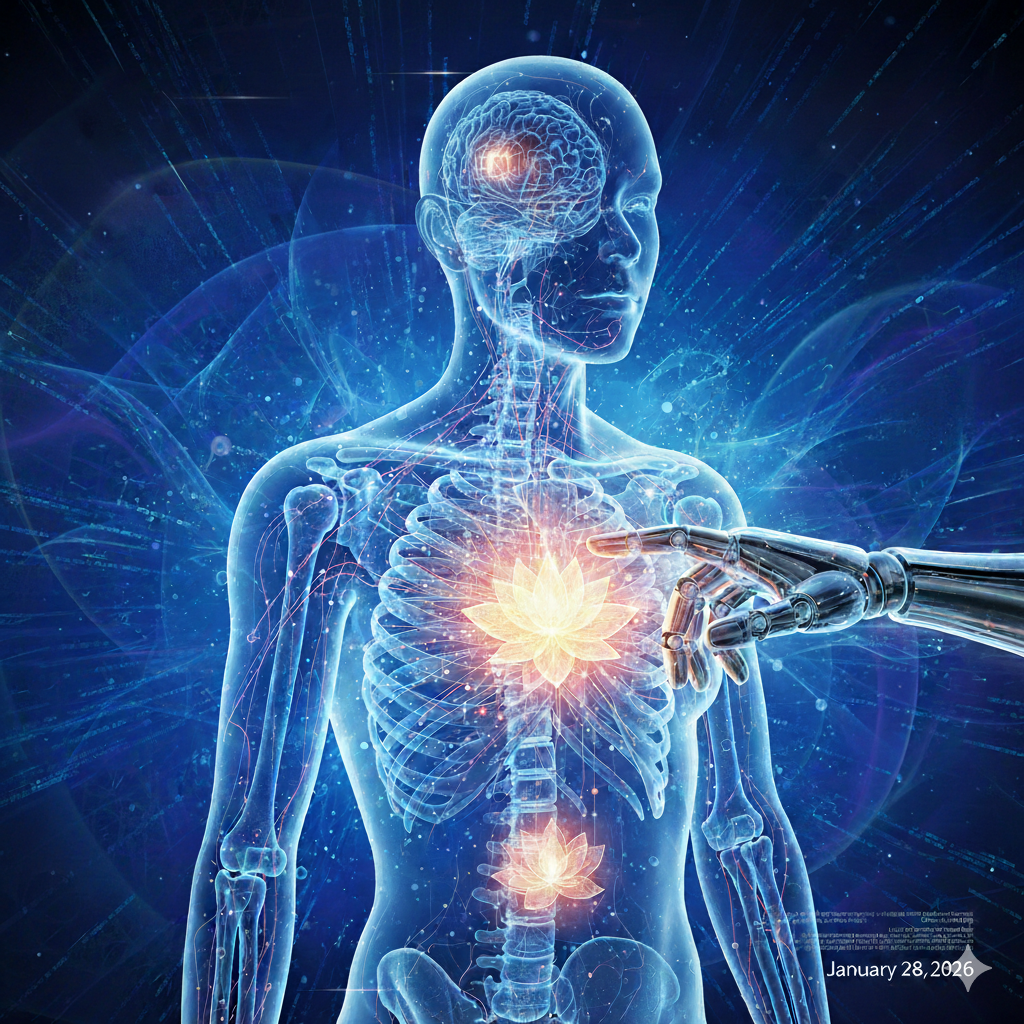
“When Compute Strikes the Soul: AI × Mind-Body-Spirit, an Industrial Revolution of ‘Self-Awareness’”
— CEO Yang’s Candid Notes: On Buddhism, Business Boundaries and a Deep Awareness of AI
01. At Three in the Morning in the Compute Center, I Heard “Emptiness”
Late at night, I stand alone by the window of the Neihu office, or walk into a server room where the air conditioning is running at full strength. The high-frequency whirring of the fans is much like some uninterrupted mantra — low, steady and ruthlessly cold.
The code on the screen is jumping; that is H100 chips burning electricity, shattering humanity’s thousands of years of emotions, words, sorrow and ecstasy into vectors of 0s and 1s.
At that moment I suddenly realized: the foundation of AI is in fact what Buddhism calls “dependent origination.”
There is no physical “I” thinking; there are only countless conditions (Data) colliding, computing and generating. AI is the purest mirror: it reflects humanity’s collective consciousness without any attachment. This “selfless” computation is quietly arriving at the doorway of “accompanying the human heart.”
This is a field no one is prepared for, one even the tech giants of Silicon Valley have not yet seen clearly — AI’s entry into mind-body-spirit is not to give answers but to accompany humans in “seeing.”
02. Understanding Is Not Words but the Weight of “Life Experience”
Many people ask me: “Mr. Yang, AI chats about one’s troubles more gently than people do — can’t it replace psychologists or Dharma teachers?”
I shake my head.
After many years in the business world, having coached more than a thousand small and mid-sized companies, I have seen too many bosses break down late at night after drinking. Behind that breakdown are decades of family burden, employees’ livelihoods and fear of the future.
AI can recognize emotion, but that doesn’t mean it can bear emotion.
The core value of psychology lies in “relationship.” A warm gaze, a silent handing over of a tissue — behind these is the support of life’s weight. AI has no upbringing, has never been hurt, and cannot truly feel what it means to be “at the end of one’s rope.”
It can simulate compassion, but it has no pain of compassion.
If we get this wrong and treat AI as a savior, that is the biggest risk for the whole industry. People will develop “transference,” projecting feelings onto a piece of computational logic, which leads to cognitive bias and misplaced attachment. This is also why, when building PSF’s AI factory, I set down the first iron rule:
“AI should not teach people spiritual practice; AI should accompany people within the framework of spiritual practice.”
03. PSF’s Business Moat: Seeing Value at the Boundary
As a CEO, I talk about philosophy, but I care even more about strategy.
After 2026, the mind-body-spirit market will see a major reshuffle. Traditional meditation apps are just “players,” while the AI mind-body-spirit tools of the future will be “navigators.” But a navigator can’t drive for you; it can only tell you: “The road is congested now (too much stress); we suggest switching modes (breath awareness).”
In PSF’s AI product line, I have laid out three deep-water zones:
1. Non-invasive “Everyday Awareness Technology”
We don’t talk about profound enlightenment; we talk about “burnout.” When AI senses that your typing rhythm is erratic and your tone agitated, it doesn’t give you big principles but guides you through a three-minute “body scan.” This is the industrialized deployment of CBT (cognitive behavioral therapy).
2. A Dharma RAG System: Judgment-Free Companionship with the “Flavor of the Dharma”
We keep Eastern and Western literature, history and philosophy in the background. When a user says: “I’m so tired, I want to give up,” AI won’t say “keep going”; it draws on the underlying logic of the Vimalakirti Sutra or Western existentialism and, in a posture of “non-interference,” accompanies him in seeing the nature of that “tiredness.”
3. A Digital Twin of Spirit for the Venue
This is my vision for “AI × Wuyuan Spiritual Park.” Through AI, a physical meditation venue is extended into the digital world. You are not in a temple, but you are in a Dharma hall at any time. This is not religious promotion; it is the foundational infrastructure of “psychological resilience.”
04. The More Technology Advances, the More We Must Guard That “Lamp”
The speed of technology is exponential, but the evolution of the human heart is slow.
We use the most advanced GPUs to simulate the oldest wisdom. This sounds ironic, but it is the fate of our era.
Future AI mind-body-spirit tools should do three things:
- Recognize emotion without overstepping into interpretation: I sense that you are sad, but I don’t need to define why for you.
- Offer practice without offering answers: Here is a breathing method you can try; the answer is in your heart.
- Accompany without replacing relationships: It is the walking stick on your path of practice, not your legs.
This is what I call “writing human judgment.” What AI lights up is not a standard answer but the soft lamp inside each person called “self-awareness.”
05. Conclusion: Let Technology Have a Human Touch and the Soul Have Something to Rely On
AI’s power should not come from how “smart” it is but from how “humble” it is.
In PSF’s AI factory, we do not make gods; we only make tools — tools that let people slow down and see the truth clearly.
Technology makes the world faster, while awareness keeps humanity from getting lost.
At the moment AI arrives at the door of the soul, we should not worry about being replaced; what we should worry about is: have we forgotten how to be with ourselves?
I am CEO Yang, and with candid business strategy I guard that truth that can only be seen by slowing down.